What to Do If You're House Poor in Ontario

Feeling house poor doesn't automatically mean you should sell. In most of the situations I see, there are two or three ways to cut the monthly squeeze that cost far less than the roughly $58,000 in friction it takes to sell a $750,000 home and buy something smaller in Ontario. Selling is sometimes the right call — I'll tell you exactly when below — but it should be your last resort, not your first instinct.
Why you feel trapped (and why it's not your fault)
If you bought between 2020 and 2022, you likely locked a fixed rate under 2%. Those mortgages are now renewing into a world where strong 5-year fixed rates start around 4.19% and variables around 3.55% (as of this week — rates move; see today's estimates on our rates page).
Here's what that looks like for a typical Bradford-area family — real numbers from our own mortgage engine:
The 2021 buyer: $750,000 home, $600,000 mortgage at 1.89% fixed, 25-year amortization → $2,509/month. At renewal this year the balance is about $501,000 — and renewing at 4.19% over the remaining 20 years pushes the payment to $3,080/month. That's $571 more, every month, for the same house. Add a car payment and a grocery bill that's grown too, and "suffocated" is the right word.
You didn't mismanage anything. The math changed underneath you.
The real cost of selling your way out
Selling feels like the escape hatch — until you price the hatch. Selling that $750K home and buying a $650K one typically costs:
| Cost | Estimate |
|---|---|
| Realtor commission (commonly ~5% + HST) | ~$42,400 |
| Ontario land transfer tax on the $650K purchase | $9,475 |
| Legal fees — two transactions | ~$4,000 |
| Inspection, moving, incidentals | ~$2,500 |
| Total friction | ~$58,000 |
That's $58,000 of your equity gone — not to your family, to the transaction. And if you sell mid-term, a fixed-rate breaking penalty (often an interest-rate-differential calculation) can add thousands more. This is why "just sell" deserves real math before it deserves a listing. You can sanity-check the tax line yourself with our land transfer tax calculator.
Five ways to breathe again — without selling
1. Don't sign your renewal letter — shop it. Your bank's first renewal offer is rarely its best. Switching lenders at renewal usually requires no penalty, and on a $501K balance even 0.20% is about $55 a month. (For context on where rates sit after the Bank of Canada's latest decision, here's what the July hold means for your mortgage.)
2. Refinance and re-extend your amortization. This is the biggest lever. Refinancing that $501K balance back out to 30 years at roughly 4.59% (refinance rates run a little above the insured "from" rates) makes the payment about $2,555/month — roughly $525 a month less than the 20-year renewal, and within $50 of what you paid at 1.89%. Yes, a longer amortization means more interest over time — that's the honest trade-off — and you can shorten it again later with prepayments when life loosens up. Run your own numbers on the refinance break-even calculator.
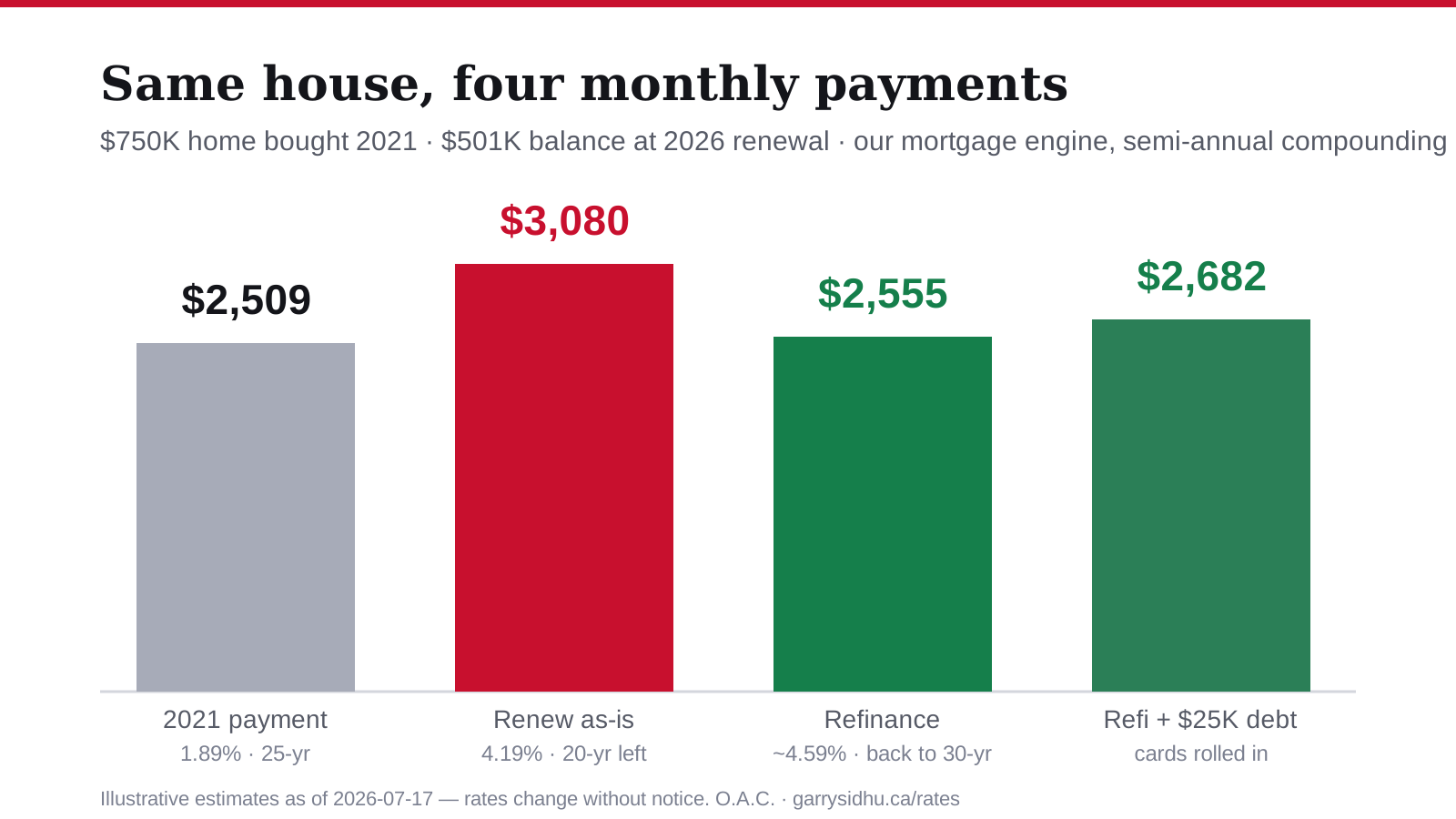
3. Consolidate the expensive debt. If the squeeze has pushed $25,000 onto credit cards at around 21%, you're paying roughly $690 a month — mostly to interest. Rolling it into the refinance above makes the all-in payment about $2,682/month — over $1,000 a month less than the renewal-plus-cards path. One payment, one rate, actual breathing room.
4. Use equity as a safety valve — carefully. A HELOC on your equity can smooth a rough year (parental leave, a layoff, a slow season for your business). It's a tool, not free money: interest-only minimums feel light, but the balance doesn't shrink itself. I'll tell you honestly whether this one fits your situation.
5. Make the house help pay for itself. A legal basement suite in the Bradford–Barrie market commonly rents in the $1,500–$2,000 range depending on the suite. Ontario now broadly permits additional residential units in most urban homes, though rules vary by municipality — check your local zoning before you build. Even renting to a single student meaningfully changes the monthly math.
When selling IS the right move
I've told clients to sell. This business runs on honesty, not on keeping people in mortgages. Selling makes sense when the payment gap survives every fix above and still doesn't fit your income; when you're carrying the house at the cost of your retirement savings or your health; or when life has genuinely moved on — divorce, relocation, a family change — and the house no longer matches it.
If that's you, sell from a position of strength: on your timeline, with your equity protected — not in a panic six weeks before renewal.
The 15-minute reality check
Before any big decision, I look at five things with you: your renewal date, your penalty (if any), your real household budget, your equity, and your goals for the next five years. Fifteen minutes usually tells us which of the five levers — or an honest sale — actually fits. The Financial Consumer Agency of Canada's mortgage guides are a good neutral primer; when you're ready for numbers on your file, that's what I'm here for.
Questions I hear every week
Should I sell my house if I can't afford the mortgage?
Not as a first move. Selling a $750K Ontario home costs roughly $58,000 in commission, taxes and fees, and most payment problems can be cut by $500–$1,000 a month through renewal shopping, re-amortizing, or consolidating expensive debt. Sell when the math still doesn't work after those fixes — or when your life has genuinely outgrown the house.
Can I lower my mortgage payment without selling or refinancing?
Sometimes. If you're at renewal, switching lenders needs no penalty and often beats your bank's letter. Some lenders also allow payment or amortization adjustments mid-term. What's available depends on your lender, equity and credit — that's a 15-minute conversation, not a guess.
Does stretching my amortization back to 30 years cost more?
Over the full life of the mortgage, yes — you pay interest longer. But it can be the difference between keeping your home comfortably and selling at a $58,000 friction cost. Many clients extend now and use prepayment privileges to shorten again when cash flow recovers. It's a strategy, not a failure.
What if I've already missed a payment?
Talk to someone now — your lender, or me. Options shrink with every missed month, and lenders have hardship tools (deferrals, capitalizations) that work far better early. A missed payment is a signal to act, not a reason to hide.
Feeling the squeeze? Get your free 15-minute reality check — build your plan at garrysidhu.ca/mortgage-plan, or tap the chat bubble and ask the AI anything, any hour. No pressure, no credit check, no obligation.
Garry Sidhu is a licensed mortgage professional (Level 2, Lic. #M21004814) with Akal Mortgages Inc. (FSRA #10845), serving Bradford, Barrie, Newmarket and all of Ontario for six years — 300+ families funded, most by referral.
This article is general information, not financial advice — talk to a licensed professional about your specific situation. Rate figures are illustrative "from" estimates as of 2026-07-17 for well-qualified files and change without notice. O.A.C.
✓ You're in! Open your checklist here →
Have a question about your mortgage?
Get a straight answer and your options — free, no credit check.