Which Provinces Get the Most Federal Funding in 2026?

Quebec receives the most federal money in total — $30.3 billion in 2026-27. Nunavut receives the most per person, at $57,594. Ontario sits second in total dollars at $29.8 billion, but tenth out of thirteen per person, at $1,817.
That gap between "most money" and "most money per person" is the whole story, and it explains something Ontario buyers feel every time they close on a house.
The figures below are the federal government's own, from the Department of Finance Canada's major transfers tables for the 2026-27 fiscal year, last updated 11 December 2025.
Federal funding by province and territory, 2026-27
Total federal support across all provinces and territories comes to $108.4 billion in 2026-27, or $2,577 per Canadian. Here is how it splits:
| Rank | Province / Territory | Total federal support |
|---|---|---|
| 1 | Quebec | $30,256M |
| 2 | Ontario | $29,750M |
| 3 | British Columbia | $10,259M |
| 4 | Alberta | $9,235M |
| 5 | Manitoba | $7,781M |
| 6 | Nova Scotia | $5,517M |
| 7 | New Brunswick | $4,939M |
| 8 | Nunavut | $2,434M |
| 9 | Saskatchewan | $2,305M |
| 10 | Northwest Territories | $1,991M |
| 11 | Yukon | $1,667M |
| 12 | Newfoundland and Labrador | $1,173M |
| 13 | Prince Edward Island | $1,055M |
Ranked this way, the list mostly just follows population. Quebec and Ontario are first and second because they are the two biggest provinces. That ranking is close to meaningless on its own.
The ranking that actually tells you something: per person
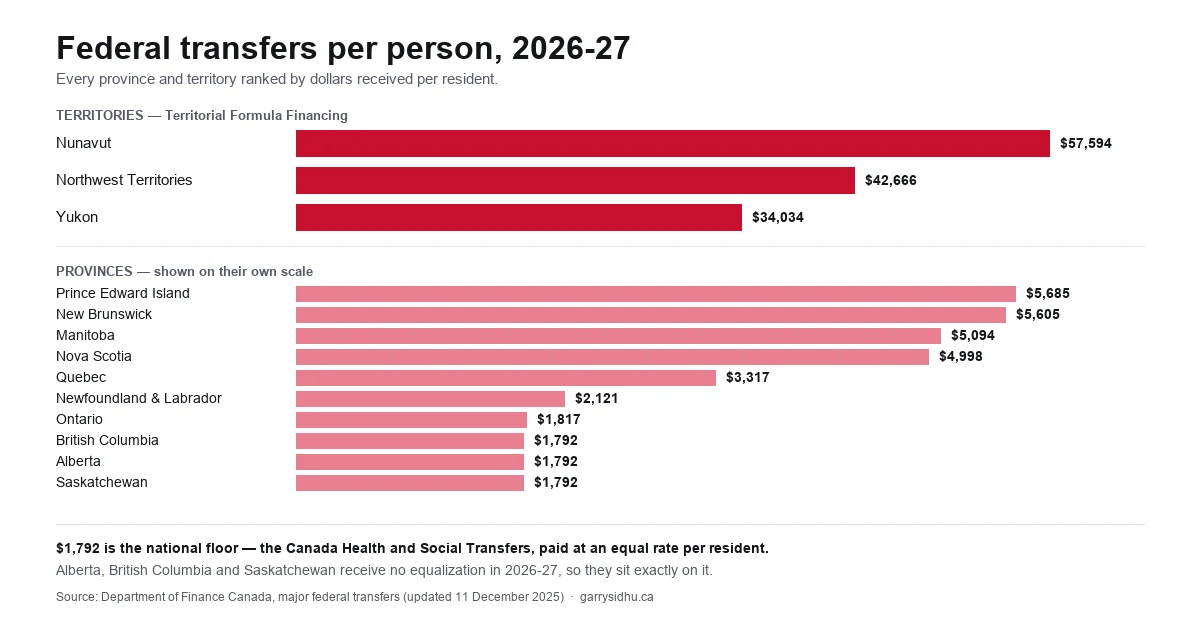
Divide by population and the order turns upside down.
| Rank | Province / Territory | Per person |
|---|---|---|
| 1 | Nunavut | $57,594 |
| 2 | Northwest Territories | $42,666 |
| 3 | Yukon | $34,034 |
| 4 | Prince Edward Island | $5,685 |
| 5 | New Brunswick | $5,605 |
| 6 | Manitoba | $5,094 |
| 7 | Nova Scotia | $4,998 |
| 8 | Quebec | $3,317 |
| 9 | Newfoundland and Labrador | $2,121 |
| 10 | Ontario | $1,817 |
| 11 | British Columbia | $1,792 |
| 11 | Alberta | $1,792 |
| 11 | Saskatchewan | $1,792 |
Quebec drops from first to eighth. Ontario lands tenth, below the $2,577 national average. And three provinces tie at the bottom on exactly the same number.
Why British Columbia, Alberta and Saskatchewan all get precisely $1,792
That identical figure is not a coincidence — it is the floor. Two of the four major transfers, the Canada Health Transfer and the Canada Social Transfer, are handed out on a strict equal-per-person basis. Every Canadian is worth the same amount under those two programs no matter where they live.
$1,792 per person is what a province receives when it gets those two transfers and nothing else. Alberta, British Columbia and Saskatchewan all show a dash in the equalization column for 2026-27 — they qualify for none.
So the real question is never "how much does a province get." It is "how far above the floor does it sit, and why." Everything above $1,792 is equalization (for provinces) or Territorial Formula Financing (for the three territories).
Ontario is a useful example. Its $1,817 is only $25 above that floor, coming from a modest $406 million equalization payment against $22.4 billion in health transfers and $7.0 billion in social transfers.
Why the territories look so extreme
Nunavut's $57,594 per person is real, and it is not equalization. Of Nunavut's $2,434 million, some $2,358 million — roughly 97 per cent — is Territorial Formula Financing.
TFF exists because delivering services to about 40,000 people spread across two million square kilometres, in communities with no road connections, costs a fortune per resident. Fuel arrives by sealift. A nurse's housing has to be built and heated. The per-person figure is large because the denominator is tiny and the costs are genuinely enormous.
Comparing Nunavut's per-person number to Ontario's is not really a like-for-like comparison, which is why these rankings get misread so often.
What this has to do with the price of an Ontario house
Here is the part that reaches your mortgage.
Ontario collects the second-largest federal transfer in the country and one of the smallest per resident. The province funds its schools, hospitals, transit and infrastructure largely out of its own tax base. When a province has to raise more of its own revenue, it leans harder on the levers it controls — and in Ontario, several of those levers sit directly on top of a home purchase.
Two of them show up on every closing statement:
- Ontario land transfer tax, charged province-wide, and charged a second time inside the City of Toronto — the only municipality in the province with its own version.
- Municipal development charges, which a builder pays per new unit and passes into the purchase price. These are among the highest in Canada in parts of the Greater Toronto Area.
Neither is a federal transfer question on its face. But both exist because Ontario and its municipalities fund a large share of their own costs, and both land in the cash a buyer needs on closing day.
This matters practically, because land transfer tax cannot be added to your mortgage. It is a closing cost, paid from your own funds, on top of your down payment. A buyer purchasing at $800,000 in Barrie pays provincial land transfer tax only; the same purchase inside Toronto attracts the municipal charge as well, roughly doubling that line. First-time buyers can claim a rebate against both, which changes the number materially.
If you are working out what you actually need in the bank, the closing costs calculator and the land transfer tax calculator will give you the real figure for your price point and municipality. If the number surprises you, that is worth a conversation before you make an offer — call and we can work through it in a few minutes.
The mistake people make with these numbers
"Equalization means my province is subsidising theirs." It does not work that way. Equalization is paid entirely out of federal general revenue — there is no provincial cheque, and no province transfers money to another province. Albertans pay federal tax like everyone else, and the federal government funds the program from all federal revenue.
The formula measures a province's ability to raise revenue at average tax rates. A province with strong resource and income revenue clears the bar and receives nothing, which is exactly what the dash beside Alberta, British Columbia and Saskatchewan means for 2026-27.
Where to check these numbers yourself
All figures here come from the Department of Finance Canada major federal transfers tables, which publish allocations by province and territory and are updated each December for the following fiscal year. The 2026-27 figures were last updated 11 December 2025.
This article explains public funding data and general Ontario closing costs. It is information, not financial advice — talk to a licensed mortgage professional about your own situation. Figures reflect the Department of Finance Canada tables as published for 2026-27 and last updated 11 December 2025. Last updated 30 July 2026.
Sorry — that didn't send. Please call (437) 961-0004 and Garry will add you.
✓ You're in! Open your checklist here →
Frequently asked questions
Which province gets the most federal funding in 2026?
Why do Alberta, British Columbia and Saskatchewan all receive the same amount per person?
Does Ontario receive equalization payments?
Do federal transfers to a province affect house prices there?
Can I add Ontario land transfer tax to my mortgage?
Have a question about your mortgage?
Call and you'll get me, not a queue — most questions are answered on the spot. Free, no credit check.
📞 Call (437) 961-0004Can't talk right now? Pick a 15-minute slot.