Where Canadians are moving (and leaving): the top 5 cities each way

In one year, the Toronto region lost 77,492 people to the rest of Canada. That is more than the top five fastest-gaining cities picked up combined. Here is where Canadians actually moved, and where they left.
I ranked every city in Canada by one simple number: how many more people moved in from the rest of the country than moved out. Not a percentage. A head count.
How I counted
- The data: Statistics Canada's official population estimates for 152 cities and city regions, covering July 1, 2024 to July 1, 2025. These are the newest city-level numbers. They came out in January 2026.
- "Moving" means people arriving from another province, plus people arriving from somewhere else in the same province, minus everyone who left for either.
- Immigration is shown separately. New arrivals from other countries are a different story, and they would bury the moving story under the biggest cities. You will see them in the Toronto chart below.
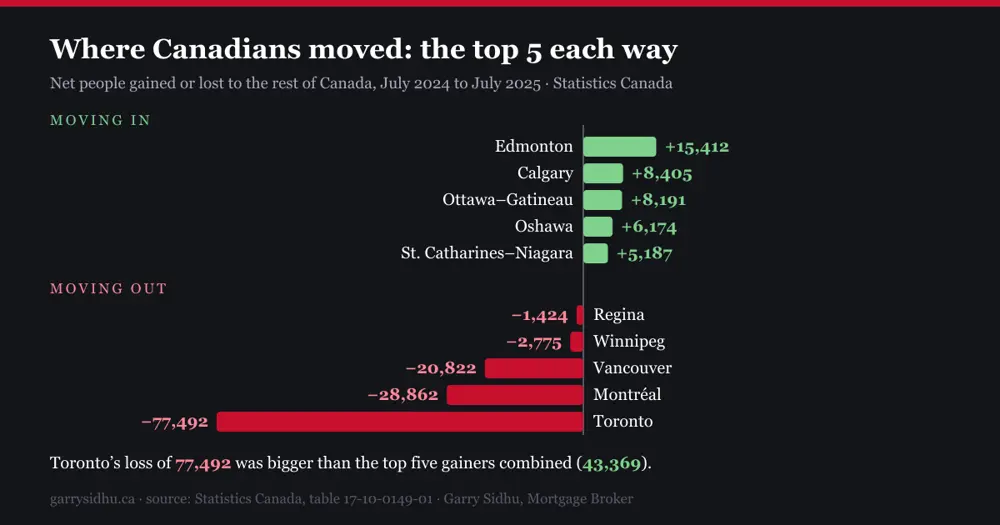
The top 5 places people are moving to
1. Edmonton: +15,412
Edmonton pulled in 11,742 people from other provinces, more than any other city in Canada, plus another 3,670 from elsewhere in Alberta. It was also the fastest-growing big city in the country, up 3.0% in a single year.
2. Calgary: +8,405
Calgary drew 11,195 people from other provinces, nearly as many as Edmonton. It lost 2,790 to the rest of Alberta, which is why it lands second. Counting everyone, including new immigrants, Calgary grew by 52,351 people, the biggest gain of any city in Canada.
3. Ottawa–Gatineau: +8,191
The capital region won both ways: 3,531 more people from other provinces and 4,660 more from elsewhere in Ontario and Quebec.
4. Oshawa: +6,174
Almost all of Oshawa's gain came from inside Ontario: 6,921 more people arrived from elsewhere in the province than left for it.
5. St. Catharines–Niagara: +5,187
Same pattern. Niagara gained 5,828 people from elsewhere in Ontario.
Notice the split. Alberta pulls people from across the whole country. Ontario's winners pull people from inside Ontario, mostly places within driving distance of Toronto.
The top 5 places people are leaving
1. Toronto: −77,492
The Toronto region lost 12,698 people to other provinces and 64,794 to the rest of Ontario. That sounds dramatic, but it is actually smaller than the year before, when the loss was 93,256.
2. Montréal: −28,862
Montréal lost 6,114 people to other provinces and 22,748 to the rest of Quebec.
3. Vancouver: −20,822
Vancouver lost 4,656 people to other provinces and 16,166 to the rest of British Columbia.
4. Winnipeg: −2,775
Winnipeg lost 3,463 people to other provinces but gained a few hundred from elsewhere in Manitoba.
5. Regina: −1,424
Regina lost 1,689 people to other provinces and gained 265 from the rest of Saskatchewan.
Here is the good news hiding in this list: losing movers does not mean shrinking. Montréal still grew by 25,024 people, Winnipeg by 11,748, Vancouver by 6,323 and Regina by 6,148, thanks to new immigrants and more births than deaths. The biggest cities work like a front door. People arrive from around the world, settle in, and many later move somewhere nearby with more space for the money.
Toronto's year, in one picture
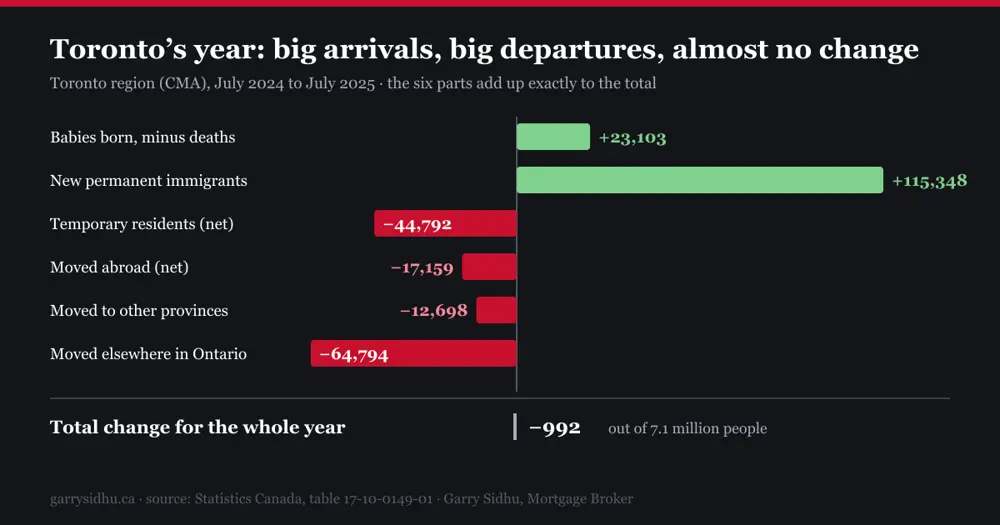
This is the most surprising chart in the whole report. Toronto welcomed 115,348 new permanent immigrants and had 23,103 more births than deaths. And yet its population went down by 992 people, out of 7.1 million.
Why? Three things pulled the other way at once: 64,794 people moved elsewhere in Ontario, the number of temporary residents (students and workers on permits) fell by 44,792, and more people moved abroad than came back. One year earlier, Toronto grew by 269,143. That is how fast things changed.
Where moves within Ontario landed
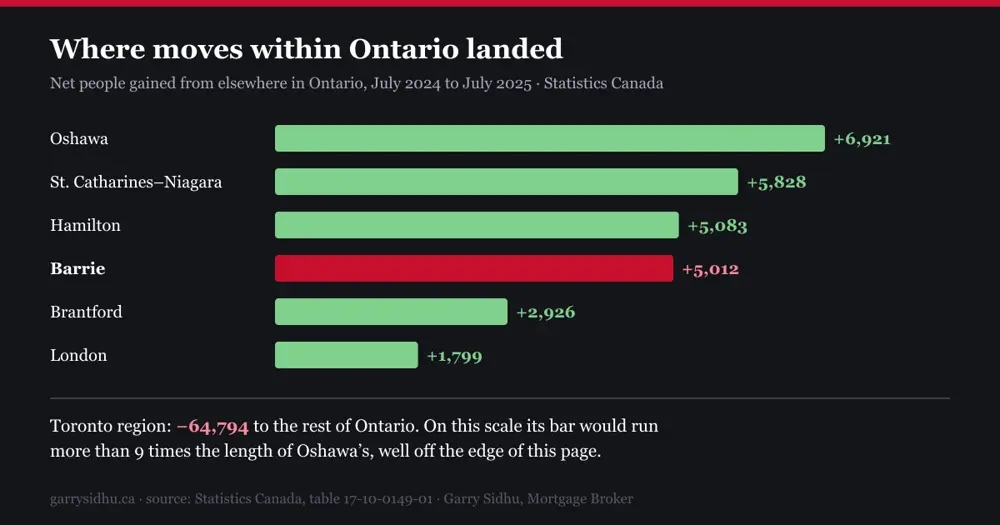
These are the Ontario cities that gained the most people from the rest of the province. The numbers are net totals, so they do not tell us exactly where each family came from. But the pattern is hard to miss: a ring of cities within reach of Toronto, from Durham to Niagara to Barrie.
Barrie is the one to watch around here. Counting every direction, it gained 4,239 people from the rest of Canada, the seventh most of any city in the country and up from 3,408 the year before.
What about Bradford?
Here is a fun detail. Statistics Canada counts Bradford West Gwillimbury as part of the Toronto region. So when a family moves from Toronto to Bradford, it does not show up in these numbers at all. It is a move inside the same region. Bradford's own census tells that story instead: the town grew from 35,325 people in 2016 to 42,880 in 2021, up 21.4%. For what is coming next there, see my Bradford Bypass tracker.
Five fun facts from the numbers
- Toronto's net loss to the rest of Canada (77,492) was bigger than the top five winners' gains combined (43,369).
- Toronto added 115,348 new permanent immigrants and still shrank, by 992 people.
- Alberta has gained more people from other provinces than any other province for 15 quarters in a row. That is almost four years.
- Calgary had the biggest total growth of any city in Canada: 52,351 people in one year.
- From January to March 2026, deaths outnumbered births across Canada, by 155.
What has happened since
The city numbers stop at July 2025. Newer figures exist for provinces, and they show the same direction:
- Alberta is still number one. From January to March 2026 it gained 6,006 people from other provinces.
- Ontario is still losing the most to other provinces: 5,774 in the same three months.
- British Columbia has turned the corner. It has gained people from other provinces for four quarters in a row, most recently 1,581.
- Canada's total population dipped by 55,025 in those three months, mostly because the number of temporary residents fell by 117,879.
Statistics Canada updates the provincial numbers again in September 2026, and the next city numbers are due around January 2027. I will update this page when they do.
What this means if you are buying or selling
- Buying in Oshawa, Niagara, Hamilton or Barrie? A steady flow of people moving in supports demand over time. It has not stopped prices from easing, though. In August 2026 a typical home in Oshawa was down 5.80% from a year earlier. I broke down every area in where GTA home prices rose and fell this year.
- Selling in Toronto to buy somewhere cheaper? You may be able to take your current mortgage with you to the new home, or you may need to break it and pay a penalty. If you buy before you sell, bridge financing can cover the gap. Those choices can be worth thousands of dollars, so work them out before you sign anything.
- Trading the city for a bigger lot? A well, a septic system or extra acreage changes which lenders will say yes. I covered that in rural mortgages around Bradford and Bond Head.
- Buying your first home outside Toronto? Start with what it really costs to buy your first home in Bradford. The same math works for most towns in the ring.
Where these numbers come from
- Statistics Canada, The Daily: Canada's population estimates, subprovincial areas, January 14, 2026
- Statistics Canada, table 17-10-0149-01: components of population change by census metropolitan area and census agglomeration, 2021 boundaries
- Statistics Canada, table 17-10-0148-01: population estimates by census metropolitan area and census agglomeration
- Statistics Canada, table 17-10-0020-01: interprovincial migration, quarterly
- Statistics Canada, The Daily: Canada's population estimates, first quarter 2026, June 17, 2026
These are Statistics Canada estimates and are revised over time. "City" here means a census metropolitan area or census agglomeration, the region around a city, not only the city itself. The numbers show net moves in and out, not where each individual person came from.
Moving, or thinking about it?
Whether you are leaving Toronto for Barrie, Oshawa or Bradford, or buying your first place outside the city, I will run your real numbers and tell you plainly what works. It costs nothing to ask.
Sorry — that didn't send. Please call (437) 961-0004 and Garry will add you.
✓ You're in! Open your checklist here →
Frequently asked questions
Where are Canadians moving to the most?
Which Canadian city are people leaving the most?
If people are leaving Toronto, why is it still so big?
Is Alberta still gaining people from other provinces?
Are people moving to Barrie?
Do these rankings include immigration?
Have a question about your mortgage?
Call and you'll get me, not a queue — most questions are answered on the spot. Free, no credit check.
📞 Call (437) 961-0004Can't talk right now? Pick a 15-minute slot.