Fixed rates are climbing before the October 28 Bank of Canada decision

Written October 5, 2026, from the lender sheet effective that morning.
The decision lands here. The Bank of Canada announces at 10:00 a.m. Eastern on Wednesday, October 28. This page is updated that morning with what it decided, what happens to prime, and what it means for a variable payment.
For most of this year the question was when rates would come down. In the last nine weeks the question quietly changed. Fixed mortgage rates have been climbing, and on October 28 the Bank of Canada could raise its rate for the first time in this cycle.
I record the rate sheet every week, so I can show you what actually happened rather than describe it.
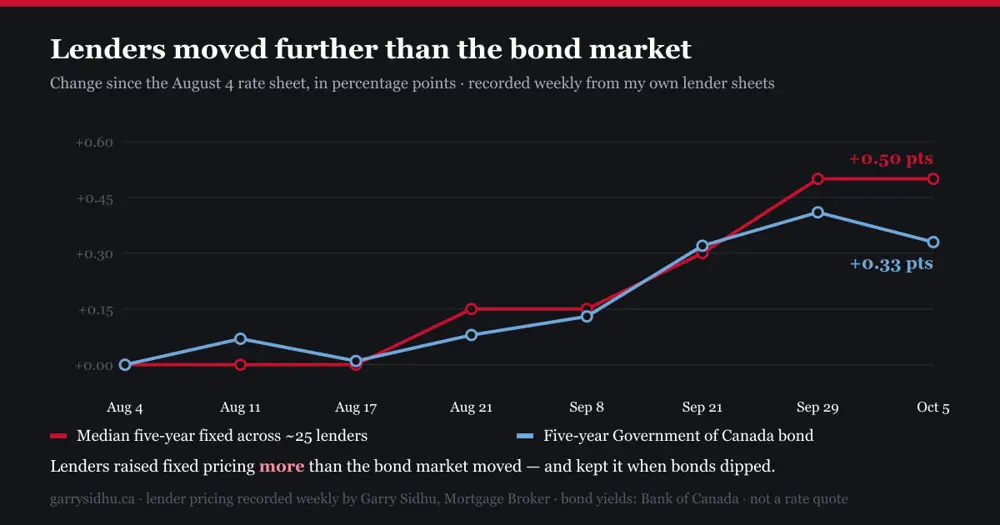
What actually moved
Across roughly 25 lenders, the median five-year fixed rate went from 4.39% to 4.89% in nine weeks. The best rate I could publish went from 4.24% to 4.54%.
On a $600,000 mortgage over 25 years, that median move costs about $168 a month — roughly $10,074 over a five-year term.
Here is the part worth noticing. The five-year Government of Canada bond, which fixed rates are priced off, rose 0.33 points over the same stretch. Lenders raised their pricing by 0.50. And last week the bond actually fell, from 3.68% to 3.60%, while the median lender rate did not move back down at all.
Lenders pass on increases quickly and give them back slowly. That is not a conspiracy, it is just how margin works — but it does mean waiting for lenders to "catch up" to a bond dip is usually a losing game.
What the Bank of Canada actually said
The Bank has held its policy rate at 2.25% for seven straight meetings. Prime has sat at 4.45% all year. The next decision is Wednesday, October 28.
Speaking to business leaders in Halifax in late September, Governor Tiff Macklem put it this way:
We don't want to raise our policy rate and restrain growth if inflationary pressures are contained. But nor do we want to be too slow to respond if inflationary pressures are becoming more persistent.
That second half is new. The Bank's own summary of its deliberations went further, saying a monetary response to prevent broad-based inflation could be needed before the year is out.
The backdrop: August inflation came in at 3.0%, with gasoline up 22.8% over the year. The two core measures the Bank actually targets were calmer, at 1.9% and 2.0%. The worry is energy costs and tariffs spilling into everything else.
Economists have shifted with it. TD Economics' pricing, reported at the end of September, points to four Bank of Canada hikes by mid-2027.
What nobody can tell you is what happens on October 28. Anyone quoting you a probability is quoting a market price that moves daily. I am not going to pretend to know.
Variable versus fixed, with the actual numbers
This is where the panic usually starts, so let us do the arithmetic instead.
| Rate today | Payment on $600,000 | You must qualify at | |
|---|---|---|---|
| Best five-year fixed | 4.54% | $3,334 | 6.54% |
| Best five-year variable | 3.6% (prime − 0.85) | $3,027 | 5.60% |
Variable is currently 0.94 points cheaper than fixed. If the Bank raises by a quarter point on October 28, a variable rate goes to about 3.85%, which adds roughly $80 a month on $600,000.
It would take about four quarter-point hikes for variable to cost what fixed costs today. That is not a recommendation — variable carries real risk and a fixed payment buys certainty, which is worth money to plenty of households. But "rates might go up" on its own is not a reason to switch.
There is a second thing hiding in that table. Because the stress test is your rate plus two points, variable qualifies you at 5.60% while fixed qualifies you at 6.54%. If you are buying at the edge of what you can afford, that gap decides deals.
Five things worth doing before October 28
- Find your renewal date. If it is inside six months, this is the week to act, not December.
- Get a rate hold. Most lenders will hold a rate 90 to 120 days. It costs nothing and it protects you if fixed pricing keeps climbing. If rates fall instead, you take the lower one.
- Test your budget one point higher. Not because I expect a full point, but because knowing the answer removes the fear.
- If you are on a fixed-payment variable, ask your lender how much of your payment is still going to principal. That is the number that quietly changes when rates rise.
- Do not convert variable to fixed without the penalty math. Mid-term conversions are a different decision from renewing, and the cost is specific to your contract.
Two dates to put in your phone
| Monday, October 19 | September inflation figures. This is what the Bank sees before it decides. |
|---|---|
| Wednesday, October 28 | Bank of Canada rate decision. Prime cannot move before this. |
The honest summary
Fixed rates have already risen — that part is not a forecast, it is in my sheets. Whether the Bank follows on October 28 is genuinely unknown, and the people telling you otherwise are guessing with more confidence than the evidence supports.
What you control is your own file: your renewal date, whether you have a rate hold, and whether you have shopped the spread. On today's sheet the gap between the best five-year fixed and the median is 0.35 points. On $600,000 that gap is worth about $118 a month — more than a quarter-point hike would cost you.
Rates quoted are from the lender sheet effective October 5, 2026, are subject to lender conditions and change without notice. This is not a rate quote or an approval. O.A.C. For the longer explanation of how inflation feeds through to your mortgage, see inflation and your mortgage rate.
Renewing or buying in the next six months?
Send me your renewal date, balance and current rate. I will show you what the lenders on this week's sheet would actually price your file at, and get a rate hold in place so October 28 is somebody else's problem.
Sorry — that didn't send. Please call (437) 961-0004 and Garry will add you.
✓ You're in! Open your checklist here →
Frequently asked questions
Will the Bank of Canada raise interest rates on October 28, 2026?
Are fixed mortgage rates going up in Canada right now?
Should I lock in my mortgage rate before October 28?
What happens to my variable mortgage if the Bank of Canada raises rates?
Is variable cheaper than fixed right now?
Have a question about your mortgage?
Call and you'll get me, not a queue — most questions are answered on the spot. Free, no credit check.
📞 Call (437) 961-0004Can't talk right now? Pick a 15-minute slot.