Canada's inflation hit 3% — but the numbers that set your mortgage rate barely moved

Updated 14 September 2026. Statistics Canada released August’s inflation figures this morning. Headline inflation held at 3.0%, the Bank of Canada’s core measures did not move, and Ontario rose to 2.4% — still the lowest of any province. The bigger news for mortgages this month is the bond market, covered below. The next inflation release is 19 October.
No. Canada’s headline inflation held at 3.0% in August, the same as July. The two measures the Bank of Canada actually targets stayed at 1.9% and 2.0% — at or below its 2% target. Gasoline is still the main reason the headline sits above 2%. What is moving fixed mortgage rates is the bond market, and it jumped this week.
This page is updated after every Statistics Canada inflation release. The numbers below are from the August 2026 report, published the morning of September 14, 2026.
What Statistics Canada actually reported
| Measure | August 2026 | July 2026 |
|---|---|---|
| Headline CPI (all items, year over year) | 3.0% | 3.0% |
| CPI excluding gasoline | 2.4% | 2.2% |
| CPI-trim (Bank of Canada core) | 1.9% | 1.9% |
| CPI-median (Bank of Canada core) | 2.0% | 2.0% |
| Gasoline | +22.8% | +25.7% |
| Shelter | +1.5% | +1.3% |
| Rent | +2.8% | +2.5% |
| Food from stores | +2.8% | +3.1% |
| Ontario (all items) | 2.4% | 2.0% |
Source: Statistics Canada, Consumer Price Index, August 2026, and Statistics Canada table 18-10-0256-01 for the core measures.
Read the third line, not the first
Gasoline was up 22.8% against last August, down from 25.7% in July, but still the biggest single push on the headline. Strip fuel out and inflation was 2.4%, up from 2.2%. That is the one number that moved the wrong way this month, and Statistics Canada points to two things: travel tours (up 26.1%, largely because a weak 2025 has dropped out of the comparison) and rent (up 2.8%). Shelter overall, the biggest line in most household budgets, rose 1.5%. Grocery prices rose 2.8% — below the headline for the first time since July 2024.
So the 3.0% is real, but it is still mostly a fuel story. The core measures the Bank of Canada leans on did not move. That distinction is the whole reason the Bank does not set policy off the headline number.
Ontario’s inflation is 2.4% — still the lowest of any province
Every province gets its own reading. Ontario’s rose to 2.4% in August, from 2.0% in July, and it is still the lowest of any province. Rent was part of it: Statistics Canada named Ontario, where rent rose 2.4%, as one of two provinces behind faster rent inflation nationally. If you live in Bradford, Barrie or anywhere else in the province, 2.4% is the number that describes your cost of living. Not the 3.0% that leads the news.
What changed between July and August
- Gasoline cooled, a little. Up 22.8% from a year ago, versus 25.7% in July.
- Travel tours jumped. Up 26.1%, mostly because 2025’s travel slump has dropped out of the comparison.
- Rent sped up. Up 2.8% nationally, from 2.5%, led by Manitoba and Ontario.
- Groceries slowed. Up 2.8%, below the headline for the first time since July 2024.
- Clothing got cheaper. Down 1.1% from a year ago.
- Month to month, prices fell 0.1%, or rose 0.2% once normal seasonal swings are taken out.
None of that moves the Bank of Canada. What would move it is the core measures drifting up, and in August they did not move at all.
How a mortgage rate actually gets set
This is the part most coverage skips, and it is the reason "inflation went up" does not automatically mean "your mortgage goes up." Fixed and variable rates run on two completely separate tracks.
Variable rates and HELOCs
Bank of Canada policy rate → bank prime rate → your variable rate.
The policy rate is 2.25%. Prime is 4.45%. Your variable rate is prime minus whatever discount you negotiated. The Bank held on 2 September — a seventh straight hold — so prime has not moved, and the next scheduled decision is 28 October. If you are on a variable rate, nothing in this story has changed your payment.
Fixed rates
Government of Canada bond yields → lender funding costs and margins → competition between lenders → your fixed rate.
The five-year Government of Canada bond is what five-year fixed mortgages are priced off. It has climbed through August and into September — 3.34% on 10 August, 3.42% on 2 September, and then a sharp jump to 3.65% on 11 September. Bond traders move it daily, and they are not waiting for the Bank of Canada. You can see where the resulting fixed and variable pricing sits on our current rates page.
And a bond yield moving is not the same as your rate moving. In between sits a lender deciding whether to pass it on.
What my lender sheets show — the part you can't get from Statistics Canada
Every week I review pricing across roughly 25 banks, credit unions, monoline and specialty lenders, and I keep the sheets. That archive is what lets me answer "did rates actually go up?" with a count instead of an opinion.
Between the sheets dated August 4 and August 11 — a period when the five-year bond yield rose 0.17 points at its peak — here is what happened to five-year fixed pricing:
- Twenty-three lenders quoted a five-year fixed. Three changed it. Twenty did not.
- All three moves were up, and two of them were 0.05 points.
- Thirteen of the twenty-three sat at exactly 4.39% — the market clusters far tighter than the headlines suggest.
- The full range ran from 4.19% to 4.69%. That half-point spread is worth more to you than any inflation print.
- On the variable side, exactly one lender changed its discount in two weeks.
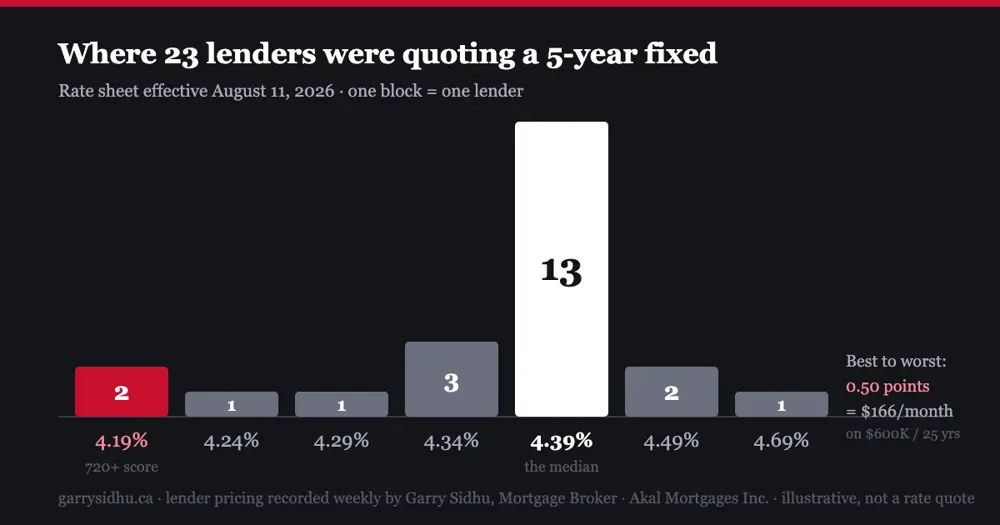
This is what a "rate increase" looks like up close: a few lenders at the sharp end pulling back while the middle of the market does nothing. Bond yields move daily. Lender sheets move in small steps, on a lag, and not all together. If you only watch the news, you see volatility that your actual mortgage options never experienced.
I wrote up that same week in more detail in the week the best rate rose and most lenders didn't move, and the full picture across all 25 lenders is in the August Ontario Mortgage Rate Report.
Five weeks of sheets: the market moved, quietly
This is the part that only exists because the sheets get kept. Here is every snapshot since the start of August.
| Sheet | Best 5-year fixed | Median across the sheet |
|---|---|---|
| 4 August | 4.14% | 4.39% |
| 11 August | 4.19% | 4.39% |
| 17 August | 4.19% | 4.39% |
| 21 August | 4.19% | 4.54% |
| 8 September | 4.24% | 4.54% |
Watch the second column, not the first. The best rate rose 0.10 points over five weeks, which is the number that gets reported. The median rose 0.15.
And the cluster moved with it. On 11 August, thirteen of the twenty-three lenders quoting a five-year fixed sat at exactly 4.39%. Today twelve of twenty-three sit at 4.54%. That is not one lender at the sharp end pulling back — that is the middle of the market lifting together.
Which is the opposite of what the headlines have been describing. The Bank of Canada has now held seven times running, so the story most people are reading is "rates are on hold". Prime genuinely is on hold, at 4.45%. But fixed pricing does not come from prime, and fixed pricing has been climbing the whole time.
The five-year Government of Canada bond explains it: 3.34% on 10 August, up to 3.42% on 2 September — the day of the announcement — and 3.40% on 4 September. Yields rose, and lenders followed.
And it has kept going. Since the 8 September sheet, the five-year yield has climbed from 3.44% to 3.65% on 11 September — a bigger move in three days than in the whole month before it. Lenders have followed bond moves all summer, so the next sheet may well show higher fixed pricing. If you are renewing or buying in the next four months, this is the week a rate hold earns its keep.
On the variable side, nothing. Prime has not moved. The best discount on a current quote is Prime − 0.75; a deeper Prime − 0.85 is still printed on the sheet, but only on quotes more than two weeks old.
What that move actually costs
On a $600,000 mortgage over 25 years, borrowing at the median today rather than five weeks ago costs about $50 a month — roughly $3,000 across a five-year term. At the best rate on the sheet, about $33 a month.
Not dramatic. But it is real money, it happened while the policy rate did nothing, and almost nobody watching the Bank of Canada would have noticed it.
What the numbers are worth in dollars
Take a $600,000 mortgage over a 25-year amortization. Using the best and the median five-year fixed on the sheet effective 8 September:
| Rate | Monthly payment | |
|---|---|---|
| Best five-year fixed on the sheet | 4.24% | $3,234.67 |
| Median across 23 lenders | 4.54% | $3,334.19 |
| Highest on the sheet | 4.69% | $3,384.51 |
Best versus median is now $99.53 a month, $1,194 a year, and $5,972 over a five-year term — plus roughly $2,641 more still owing at the end of it, because the higher rate pays down less principal. Call it about $8,600 in total for the same house and the same term.
That gap has widened as the market moved. Five weeks ago it was closer to $5,700. Shopping is worth more now than it was in August, not less.
Now compare that to the bond market. If the whole 0.30-point jump in the five-year yield since 1 September were passed straight through to a fixed rate, it would cost about $99.53 a month on that same mortgage — the same as the gap between the best and median lender.
For the first time this summer, the market move is as big as the spread between lenders. So this month the advice is both: shop the spread, and get a rate hold in place before lenders catch up to the bond market. That is the practical argument for shopping, and it does not depend on anyone forecasting anything. You can run your own balance and amortization through the mortgage payment calculator.
Illustrative only, using the semi-annual compounding Canadian fixed mortgages are calculated on. Rates are from the lender sheet effective 8 September 2026, are subject to lender conditions — the 4.24% requires a credit score of 720 or higher — and change without notice. This is not a rate quote or an approval. O.A.C.
The mistake I see most
Treating the headline CPI as a signal to act. People read "inflation is up" and rush to lock, or read "inflation is down" and decide to wait. Both are reactions to a number that does not set their mortgage rate.
Your rate is set by which lender will price your file, at what discount, with which conditions and which penalty structure. A borrower who locked in a panic at the median rate and a borrower who shopped calmly at the best rate are about $6,000 apart over five years — and no inflation report changed that. The shopping did.
The one date that genuinely matters to you is not a CPI release. It is your renewal date, and whether you started looking 120 days before it or signed whatever letter arrived in the mail.
What to do, depending on where you stand
You have a variable rate
Prime has not moved, and it cannot move before the next Bank of Canada decision on October 28. If your budget survives a hold, holding is not a decision you have to make this week. If it does not survive a hold, that is a conversation about your payment structure, not about inflation.
You are renewing in the next six months
This is the group today's number matters least to and shopping matters most to. Most lenders will hold a rate for you 90 to 120 days ahead. Getting that hold in place costs you nothing and protects you if bond yields keep drifting up. Then compare it against the market rather than against your bank's renewal letter — that is exactly what a renewal or switch is for. The full playbook — the 120-day timeline, what auto-signing costs, and the seven questions to ask before you sign — is in don’t sign the renewal letter yet.
You are buying
Get a rate hold, and get a real pre-approval rather than an online estimate. With prime unable to move before October 28 and fixed pricing climbing with bond yields, the difference in your outcome will come from your file — income structure, credit, down payment — far more than from timing.
You have a fixed rate with years left
Today's news is genuinely not about you. Check your prepayment privileges instead; that is where the money is for you this year.
An honest word on forecasts
I am not going to tell you where rates go next. The Bank held on 2 September as expected, and the next scheduled decision is 28 October. As of early September, the tone had shifted: market pricing had moved toward the possibility of a hike before year-end rather than another cut. That is what the market thinks, not what will happen, and anyone selling you certainty about 2027 is selling you something. The reasoning behind the current stretch of holds is in my write-up of the July rate decision.
What I can tell you with evidence is what lenders are actually quoting this week, because I write it down.
Renewing or buying in the next six months?
Send me your renewal date, your balance and your current rate, and I will show you what the lenders on this week's sheet would actually price your file at — including the conditions that never make it into an advertised rate. Start with a renewal or switch review, or call me at (437) 961-0004.
Garry Sidhu is an Ontario Mortgage Broker, Licence #M21004814, operating under Akal Mortgages Inc., Brokerage Licence #10845. He helps borrowers compare mortgage options from 88+ banks, credit unions and specialty lenders across Ontario.
This article provides general information, not individualized financial or legal advice. Mortgage eligibility, rates and terms depend on the borrower, property and lender. Speak with a licensed professional about your situation. Last updated: 14 September 2026.
Sorry — that didn't send. Please call (437) 961-0004 and Garry will add you.
✓ You're in! Open your checklist here →
Frequently asked questions
Does Canada's 3% inflation mean mortgage rates go up?
Will the Bank of Canada change rates on October 28, 2026?
Why is Ontario's inflation lower than Canada's?
Does inflation affect fixed and variable mortgages differently?
Should I lock in my mortgage rate before the next Bank of Canada meeting?
Have a question about your mortgage?
Call and you'll get me, not a queue — most questions are answered on the spot. Free, no credit check.
📞 Call (437) 961-0004Can't talk right now? Pick a 15-minute slot.