Mortgage Renewal in Ontario: Don't Sign the Letter Yet

Your mortgage renewal letter is an opening offer — not a bill. You don't have to sign it, you can switch lenders at renewal with no penalty, and on a typical Ontario balance the difference between auto-signing and shopping is about $18,600 over one five-year term. Here's exactly how the 120-day play works.
Why the letter is rarely your best offer
Banks know most people auto-sign. Renewal letters are priced for that inertia — often above what the same bank would offer a brand-new client, and above what 88+ competing lenders would offer you today. It's not personal; it's just economics. The letter is what they hope you'll take, not the best you can get.
This year it matters more than ever: hundreds of thousands of Canadians who locked rates under 2% in 2020–2022 are renewing into a very different market. If that's you, the gap between a shopped rate and a shrugged-at letter is real money every single month. (Feeling more squeezed than curious? Start with what to do if you're house poor instead.)
What auto-signing actually costs
Real numbers from our mortgage engine — a $501,000 balance with 20 years remaining. Three columns: a typical renewal-letter rate, the median five-year fixed across the 23 lenders I track, and the sharpest rate on this week's sheet (see the rates page):
| Sign the letter (4.79%) | Shop to the median (4.39%) | Shop to the best (4.19%) | |
|---|---|---|---|
| Monthly payment | $3,236 | $3,129 | $3,077 |
| Interest paid over the 5-year term | $109,316 | $99,930 | $95,251 |
| Balance left after 5 years | $416,178 | $413,174 | $411,646 |
| Total better off | — | $12,390 | $18,596 |
Against the best rate that's $159 a month and $14,065 less interest — plus you exit the term owing $4,531 less, because a lower rate pays down more principal. Add those together and it's $18,596.
The middle column is the one to look at, though. The sharpest rate carries conditions — this week's requires a credit score of 720 or higher. But you don't need the sharpest rate to win. Just moving from a letter rate to the middle of the market is worth $12,390. That is the realistic outcome of one phone call, not a best case.
Rates are from the lender sheet effective August 17, 2026 and are illustrative only — not a quote or an approval. Your exact numbers depend on your file. O.A.C.
The 120-day countdown
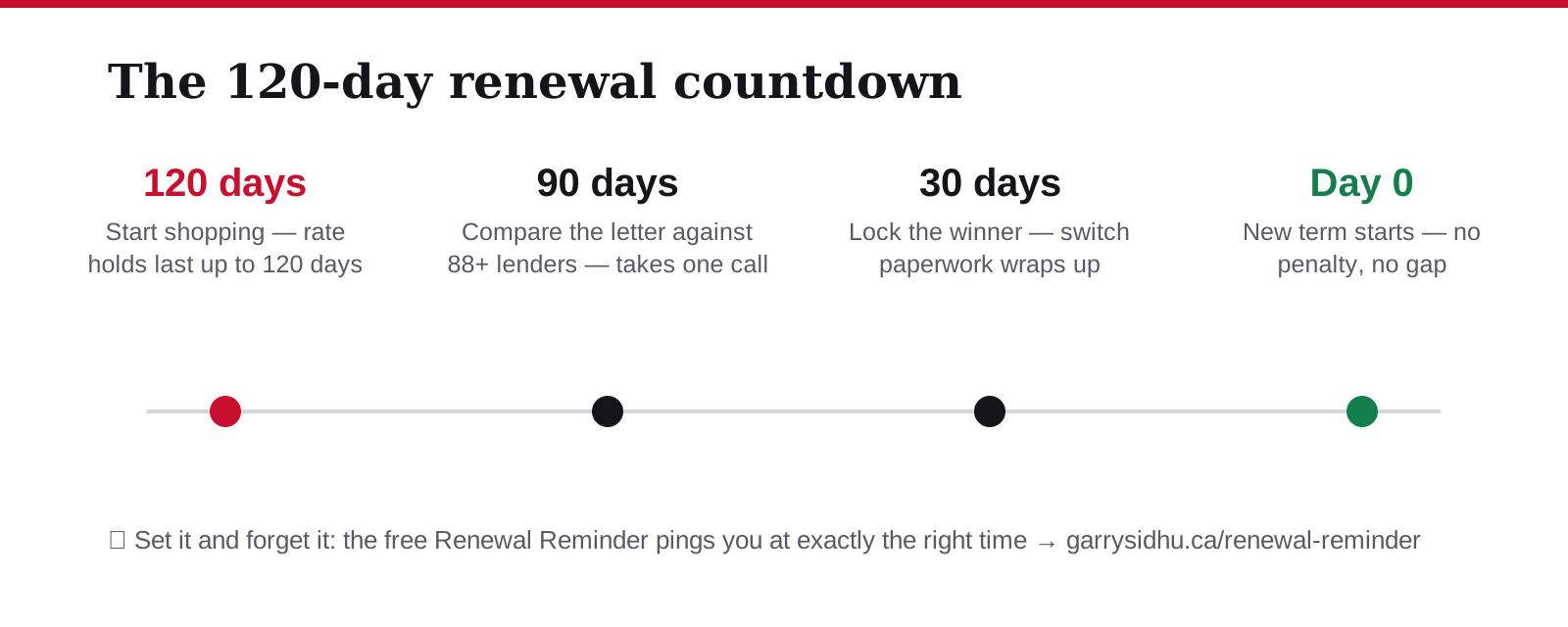
120 days out: start shopping — most lenders will hold a rate for up to 120 days, so there's zero risk in getting a competing number early. If rates drop before closing, you generally get the lower one. 90 days: put your bank's letter (when it arrives) against the market — I do this across 88+ lenders in one conversation. 30 days: lock the winner; if you're switching, the new lender handles most of the paperwork. Day 0: the new term starts. No penalty, no gap, no drama.
Don't want to track dates? The free Renewal Reminder pings you at exactly the right time — set it once and forget it.
Switch, stay, or restructure?
Stay when your bank actually matches the market — it happens, especially once they know you're shopping (funny how that works). Switch when another lender's rate or terms win: at renewal this is penalty-free, and on a straight switch you generally will not have to re-pass the stress test (see below). Restructure when your life changed: consolidating debt, pulling equity for a renovation, or re-extending your amortization to lower the payment — that's a refinance rather than a switch, and it opens different doors. Not sure which fits? That's the 15-minute conversation.
What actually happens if you do nothing
This is the part the letter never spells out. If you ignore it entirely, one of two things happens, and neither is good.
Most lenders will auto-renew you into the posted rate — the rack rate, not the discounted one they'd give a customer who asked. Some instead roll you onto an open or short-term rate, which is higher again and resets constantly.
Doing nothing is a decision. It is reliably the most expensive one on the menu, and it is the outcome the letter is priced to produce.
Seven questions to ask before you sign anything
Whether you're talking to your own bank or to me, these are the questions that separate a rate from a deal:
- Is this your best rate, or your posted rate? Ask it in those words.
- What are the prepayment privileges? How much can I pay down each year without penalty?
- How is the break penalty calculated? Interest-rate differential or three months' interest — the difference can be thousands.
- Is the mortgage portable if I move mid-term?
- Is it registered as a standard or collateral charge? A collateral charge makes switching later more work.
- What's the amortization on this renewal? Some renewals quietly reset it — which lowers the payment and costs more overall.
- Are there fees to switch to you, and do you cover them?
If a lender won't answer question 3 clearly, that's your answer.
Renewal mistakes I see every month
Signing in the first week. The letter often arrives with a "respond by" urgency that has no teeth — your renewal date is the real deadline. Waiting until the last two weeks. Switching takes some paperwork; a great rate you can't close in time is worthless. Comparing only the rate. Prepayment room, penalty math, and portability matter when life changes mid-term. Not knowing your charge type. If your mortgage is registered as a collateral charge, switching involves an extra step — good to learn 120 days out, not 12.
Questions I hear every week
Can I really switch lenders at renewal without a penalty?
Yes — renewal is the one moment your mortgage is fully open. The prepayment penalty that protects your lender mid-term doesn't apply on the maturity date. A switching lender may cover or offset transfer costs; I'll show you the exact math for your file before you decide anything.
Will I have to re-pass the stress test to switch?
On a straight switch, usually not. OSFI's published position is that it does not expect lenders to apply the minimum qualifying rate to uninsured straight switches at renewal — a straight switch meaning you move between federally regulated lenders with no increase to the loan amount and no increase to the amortization.
Two honest caveats. OSFI says it "does not expect" lenders to apply it, which is guidance, not a ban — an individual lender can still run its own test. And the moment you borrow more or stretch the amortization, it stops being a switch and becomes a refinance, where normal qualifying applies. We establish which lane you're in before anyone pulls a credit report.
When should I actually start?
120 days before your renewal date — that's when rate holds begin. Starting early costs nothing and protects you in both directions: rates rise, you're locked; rates fall, you take the better number.
What if my finances got worse since I got the mortgage?
Tell me early — it changes the strategy, not the outcome. Your current lender will usually renew you regardless (they'd rather keep you than lose you), which gives us a guaranteed floor while we quietly check whether anyone still beats it.
Renewal on the horizon? Set the free Renewal Reminder and I'll nudge you at the perfect time — or if you're inside 120 days, build your plan now or tap the chat and ask "what should I do about my renewal?" Instant answers, and I take it from there.
Garry Sidhu is a licensed mortgage broker (Lic. #M21004814) with Akal Mortgages Inc. (FSRA #10845), serving Bradford, Barrie, Newmarket and all of Ontario for six years — referral-built, with 69 five-star Google reviews.
This article is general information, not financial advice — talk to a licensed professional about your specific situation. Rate figures are illustrative estimates as of 2026-08-20 and change without notice. O.A.C.
Sorry — that didn't send. Please call (437) 961-0004 and Garry will add you.
✓ You're in! Open your checklist here →
Frequently asked questions
Can I switch lenders at renewal without a penalty?
When should I start working on my renewal?
Do I have to requalify under the stress test if I switch lenders?
Is the rate on my renewal letter negotiable?
What happens if I do nothing and let it auto-renew?
Have a question about your mortgage?
Call and you'll get me, not a queue — most questions are answered on the spot. Free, no credit check.
📞 Call (437) 961-0004Can't talk right now? Pick a 15-minute slot.