Ontario Mortgage Rate Report — August 2026

The best five-year fixed mortgage rate across the 25 lenders on our sheets is 4.14%. The median is 4.39%. That 0.25-point gap is worth $4,945 on a $600,000 mortgage over one five-year term — and it is the difference most borrowers never see, because they were only ever shown one rate.
This is the first of a monthly series. The figures come from the lender rate sheets we receive weekly, not from advertised rates, and no lender is named.
What the market looks like right now
| Measure | Today |
|---|---|
| Best 5-year fixed | 4.14% |
| Median 5-year fixed | 4.39% |
| Best short-term fixed | 3.94% |
| Best variable | Prime − 0.85 = 3.60% |
| Prime rate | 4.45% |
| Bank of Canada overnight target | 2.25% |
| 5-year Government of Canada bond | 3.27% |
What the spread actually costs
Same borrower, same term, same amortization — the only difference is which lender they ended up with.
| Mortgage | At 4.14% | At 4.39% | Extra over one term |
|---|---|---|---|
| $500,000 | $2,668 | $2,737 | $4,121 |
| $600,000 | $3,202 | $3,284 | $4,945 |
| $800,000 | $4,269 | $4,379 | $6,594 |
Why fixed rates are where they are
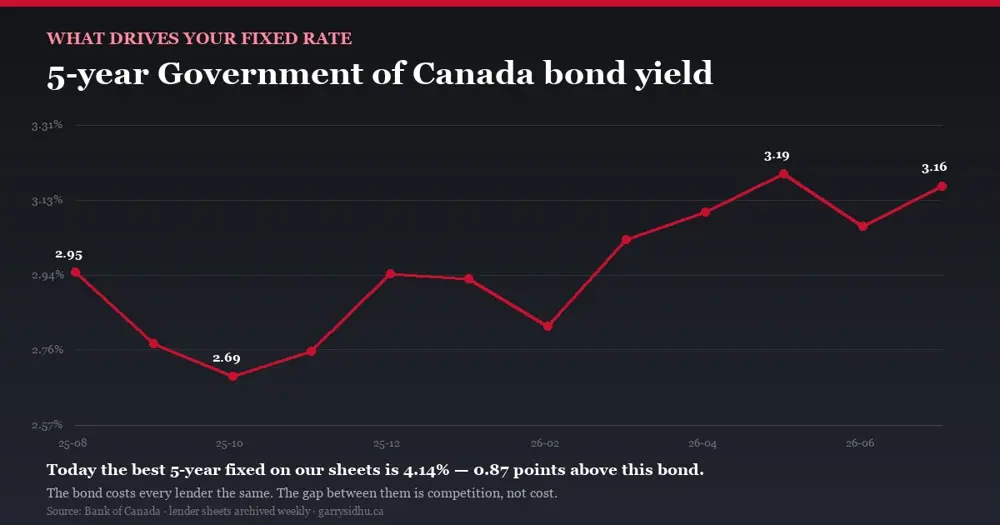
Fixed mortgage rates track the five-year Government of Canada bond yield, not the Bank of Canada's policy rate. That distinction gets lost constantly in coverage, and it is why a Bank of Canada cut sometimes does nothing to fixed pricing.
Here is where that yield has been over the past year:
| Month | 5-year GoC yield (avg) |
|---|---|
| 2025-08 | 2.95% |
| 2025-09 | 2.77% |
| 2025-10 | 2.69% |
| 2025-11 | 2.75% |
| 2025-12 | 2.95% |
| 2026-01 | 2.93% |
| 2026-02 | 2.82% |
| 2026-03 | 3.03% |
| 2026-04 | 3.10% |
| 2026-05 | 3.19% |
| 2026-06 | 3.06% |
| 2026-07 | 3.16% |
It bottomed at 2.62% on 2025-10-20 and peaked at 3.36% on 2026-05-15. It sits at 3.27% today.
The Bank of Canada's path
The overnight target has moved 2 time(s) in this window, most recently to 2.25%. That rate drives variable pricing through prime — currently 4.45% — not fixed.
What the spread over the bond is telling us
The gap between the bond and a mortgage rate is where lender margin lives. Today the best five-year fixed on our sheets sits 0.87 points above the five-year Government of Canada bond. The median sits 1.12 above it.
That difference matters more than it looks, because the bond costs every lender the same. None of them is funding at a better rate than the others. So the quarter-point between the best and the median is not a difference in the cost of money — it is a difference in how hard each lender is competing for your file this month.
And the bond itself has barely moved: 3.26% ninety days ago, 3.27% today. Whatever is happening in pricing right now is not being driven by the market. It is being driven by appetite — which lenders want volume, and which are content to be quoted and not chosen.
One more number worth sitting with: the best five-year fixed is 0.54 points higher than the best variable. Fixed carries a real premium at the moment, and that premium is what you are paying for certainty. Whether that is worth it depends entirely on how long you plan to hold the mortgage and how much a payment change would actually hurt — which is a conversation, not a rule.
If your mortgage matures in the next 120 days
Three things are true right now, and all three are worth acting on.
You can hold a rate today. Most lenders will secure one up to 120 days ahead of your maturity date. If rates fall before you close, you take the lower one. It costs nothing, and it removes the risk of waiting to see what happens.
Leaving your current lender costs no penalty. At maturity the mortgage simply ends — that is the one moment you can move without a prepayment charge. Breaking a mortgage mid-term triggers a penalty; renewing at the end of the term does not. These get confused constantly, and the confusion is expensive.
The renewal letter is an opening offer, not a bill. Lenders price those letters expecting a share of customers to sign without asking. On a typical Ontario balance, the difference between signing the letter and shopping the market runs into thousands of dollars over a single term.
One caution worth knowing before you start: moving to a new lender usually means requalifying, though the rules have eased for straight switches where the amount and amortization do not change. Staying where you are does not require requalifying — which is precisely why your current lender can afford to send you a mediocre number and wait.
Update — 11 August 2026
Rates moved inside the month, which is exactly what a weekly archive is for. The figures above are the 4 August sheet and are left as published rather than quietly rewritten — a dated report that edits its own numbers is not a record of anything.
| Measure | 4 Aug | 11 Aug | Change |
|---|---|---|---|
| Best 5-year fixed | 4.14% | 4.19% | rose 0.05 |
| Median 5-year fixed | 4.39% | 4.39% | held flat |
| Best short-term fixed | 3.94% | 3.94% | held flat |
| Best variable discount | Prime − 0.85 | Prime − 0.85 | held flat |
| 5-year GoC bond | 3.19% | 3.34% | rose 0.15 |
The detail behind the headline is the useful part. The lender holding the best five-year fixed at 4.14% repriced to 4.29% — a 0.15 move on that lender alone — and the new best is a different lender at 4.19%, conditional on a 720+ credit score. The median did not move at all.
So the market did not really shift. One lender withdrew a sharp offer, and the next-best available now carries a qualification the previous one did not. That distinction is invisible if you only track a single headline number, and it is the reason this report tracks the spread rather than one rate.
Meanwhile the bond rose 0.15 points, roughly the same distance the leading fixed offer moved. The relationship held.
How this is compiled
Lender rate sheets are archived weekly and compared. Bond and policy-rate figures come from the Bank of Canada's public data. Lender-level history begins with this issue — earlier months show bond data only, because we are not going to claim to know what lenders quoted before we started recording it.
Sorry — that didn't send. Please call (437) 961-0004 and Garry will add you.
✓ You're in! Open your checklist here →
Frequently asked questions
Why do fixed mortgage rates not drop when the Bank of Canada cuts?
What does the gap between the best and median rate actually mean?
Should I take fixed or variable right now?
How often is this report updated?
Have a question about your mortgage?
Call and you'll get me, not a queue — most questions are answered on the spot. Free, no credit check.
📞 Call (437) 961-0004Can't talk right now? Pick a 15-minute slot.